
Clicking is one of the most basic actions we perform on computers and mobile devices, yet it plays a crucial role in productivity, gaming, and daily tasks. With the rise of automation tools, many users now compare Auto Clicker vs Manual Clicking to find the most effective method.
While manual clicking offers full control and flexibility, auto clickers provide speed and efficiency for repetitive tasks. Choosing the right approach depends on your needs, whether it’s accuracy, performance, or convenience.
In this article, we will explore Auto Clicker vs Manual Clicking in detail, helping you understand their differences and decide which method works best for your workflow.
Table of Contents
Understanding the Two Approaches
Before comparing, let’s look at how both methods actually function in everyday use.
Manual clicking is a human-driven action. You physically press a mouse button or tap your screen every time an action is needed. It gives you full control but depends entirely on your speed and consistency.
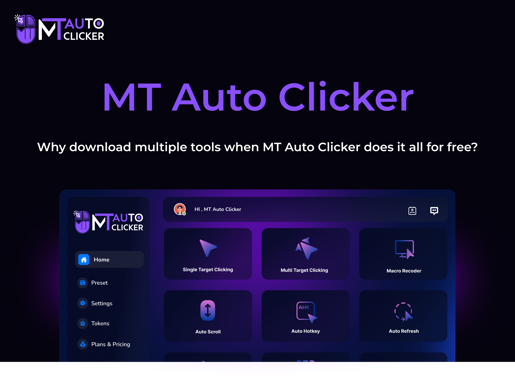
On the other hand, an auto clicker automates this process. Tools like MT Auto Clicker can perform clicks automatically based on your defined settings. This reduces manual effort and significantly increases speed.
The comparison between Auto Clicker and Manual Clicking is important when deciding how to handle repetitive tasks efficiently.
Real-World Performance Comparison
When comparing Auto Clicker vs Manual Clicking, performance is not just about speed—it also includes consistency and reliability.
Manual clicking varies from person to person. Some users can click faster than others, but fatigue quickly reduces speed and accuracy. In contrast, auto clickers maintain a consistent speed without slowing down.
For long tasks, the difference in Auto Clicker vs Manual Clicking becomes very noticeable. Automation ensures stable performance, while manual effort tends to drop after extended use.
Efficiency in Daily Tasks

Efficiency is where the gap between Auto Clicker vs Manual Clicking becomes even clearer.
Imagine you need to click a button hundreds or thousands of times. Doing this manually will take time and effort. An Auto Clicker can complete the same task in seconds or minutes, depending on the settings.
However, manual clicking still has its place. Tasks that require thinking, decision-making, or interaction with changing elements are better handled manually.
So, in terms of efficiency, Auto Clicker vs Manual Clicking depends on the type of task rather than just speed.
User Control and Flexibility

Control is another major factor in the Auto Clicker vs Manual Clicking discussion.
Manual clicking offers complete control. You decide when and where to click based on what you see on the screen. This is essential for tasks that involve dynamic content or unpredictable changes.
Auto clickers, while powerful, follow predefined instructions. They cannot adapt instantly unless configured with advanced settings.
This means that in the debate of Auto Clicker vs Manual Clicking, manual input is better for flexible tasks, while automation is better for fixed and repetitive actions.
Impact on Physical Effort
One of the most overlooked aspects of Auto Clicker vs Manual Clicking is physical strain.
Manual clicking over long periods can cause:
- Finger fatigue
- Wrist discomfort
- Repetitive strain injuries
Auto clickers eliminate this problem by automatically handling repetitive clicks. This makes them especially useful for users who perform long-duration tasks.
From a health perspective, Auto Clicker vs Manual Clicking clearly favors automation for repetitive workloads.
Gaming Perspective

Gaming is one of the most common areas where Auto Clicker vs Manual Clicking is discussed.
In idle or clicker games, auto clickers can:
- Increase speed
- Reduce grinding
- Improve progression
However, in competitive games, manual clicking is often required and preferred. Many games restrict the use of automation tools, and using them may result in penalties.
So, in gaming, Auto Clicker vs Manual Clicking depends heavily on the type of game and its rules.
Accuracy and Error Handling
Accuracy is not always about speed. It’s about doing the right action at the right time.
Manual clicking allows users to adjust instantly if something goes wrong. You can stop, correct, and continue without issues.
Auto clickers, however, continue clicking according to instructions. If the setup is incorrect, errors can repeat continuously.
This makes accuracy an important factor in Auto Clicker vs Manual Clicking, where manual control has an advantage in dynamic environments.
Learning Curve and Ease of Use
Another interesting point in Auto Clicker vs Manual Clicking is how easy each method is to use.
Manual clicking requires no setup. Anyone can start immediately.
Auto clickers require:
- Installation
- Configuration
- Testing
While tools like MT Autoclicker are beginner-friendly, they still have a small learning curve.
For beginners, manual clicking is simpler. But once learned, automation becomes more powerful.
Productivity Comparison
Productivity is where the final verdict of Auto Clicker vs Manual Clicking often lies.
Auto clickers:
- Save time
- Perform tasks faster
- Work continuously
Manual clicking:
- Slower
- Requires attention
- Limited by human ability
For repetitive and time-consuming tasks, automation significantly increases productivity.
When to Use an Auto Clicker?
Auto clickers are best used when:
- Tasks are repetitive
- Speed is important
- No decision-making is required.
- Long-duration clicking is needed.
In these situations, Auto Clicker vs Manual Clicking clearly favors automation.
When to Use Manual Clicking?
Manual clicking is better when:
- Tasks require human judgment.
- The interface changes frequently.
- Precision is critical
- Automation is restricted
Here, Auto Clicker vs Manual Clicking leans toward manual control.
Balancing Both Methods
The best approach is not choosing one over the other, but using both wisely.
For example:
- Use an auto clicker for repetitive tasks.
- Switch to manual for complex actions.
This balanced approach solves most challenges in Auto Clicker vs Manual Clicking scenarios.
Risks of Over-Reliance on Automation
While auto clickers are useful, overusing them can lead to:
- Errors if not monitored
- Violation of platform rules
- Reduced manual control
Understanding these risks is important when evaluating Auto Clicker vs Manual Clicking.
Final Verdict
So, which is more effective?
The answer depends on your needs.
- For speed and repetition → Auto clicker is better.
- For control and precision → Manual clicking is better.
The comparison between Auto Clicker and Manual Clicking is not about choosing one over the other, but about selecting the right tool for the right task.
Conclusion
The debate of Auto Clicker vs Manual Clicking highlights an important aspect of modern digital workflows—balancing automation with human control. Both methods have their strengths and limitations, and understanding when to use each can greatly improve your efficiency and productivity.
By combining the speed of automation with the intelligence of manual input, you can achieve the best results in both work and gaming environments.